Explaining Game Components and the Nintendo Way of Game Design
Putting “Play” First
The games industry releases titles that define genres, and no company has released more titles like that than Nintendo. From Super Mario Bros. to Zelda Tears of the Kingdom, the studio always takes big leaps in the industry.
But a question that usually comes up among game designers is: “how do you make these games?”
For Nintendo, the answer is putting “play” first.
In game design, our focus will always be delivering experiences to players, and one of the ways to do that is focusing on one of the four components of a game:
These are:
-
Aesthetics: the graphics, the cinematography, the movement. Ghost of Tsushima is a great example of a game that focuses on aesthetics.
-
Mechanics: the rules, items, actions and repercussions of a game. Every Mario game is a great example of how to focus on mechanics.
-
Story: the narrative of your game. Not every game has one, but many games focus on this concept to deliver the experience, like The Last of Us and God of War.
-
Technology: some games rely on new technologies to deliver new experiences. A great example is the original DOOM, which used new technology to render 2D graphics as if they were 3D, but we also have Wii Sports, Just Dance and, lately, VR games!
We can even organize them from more visible to less visible to the player:
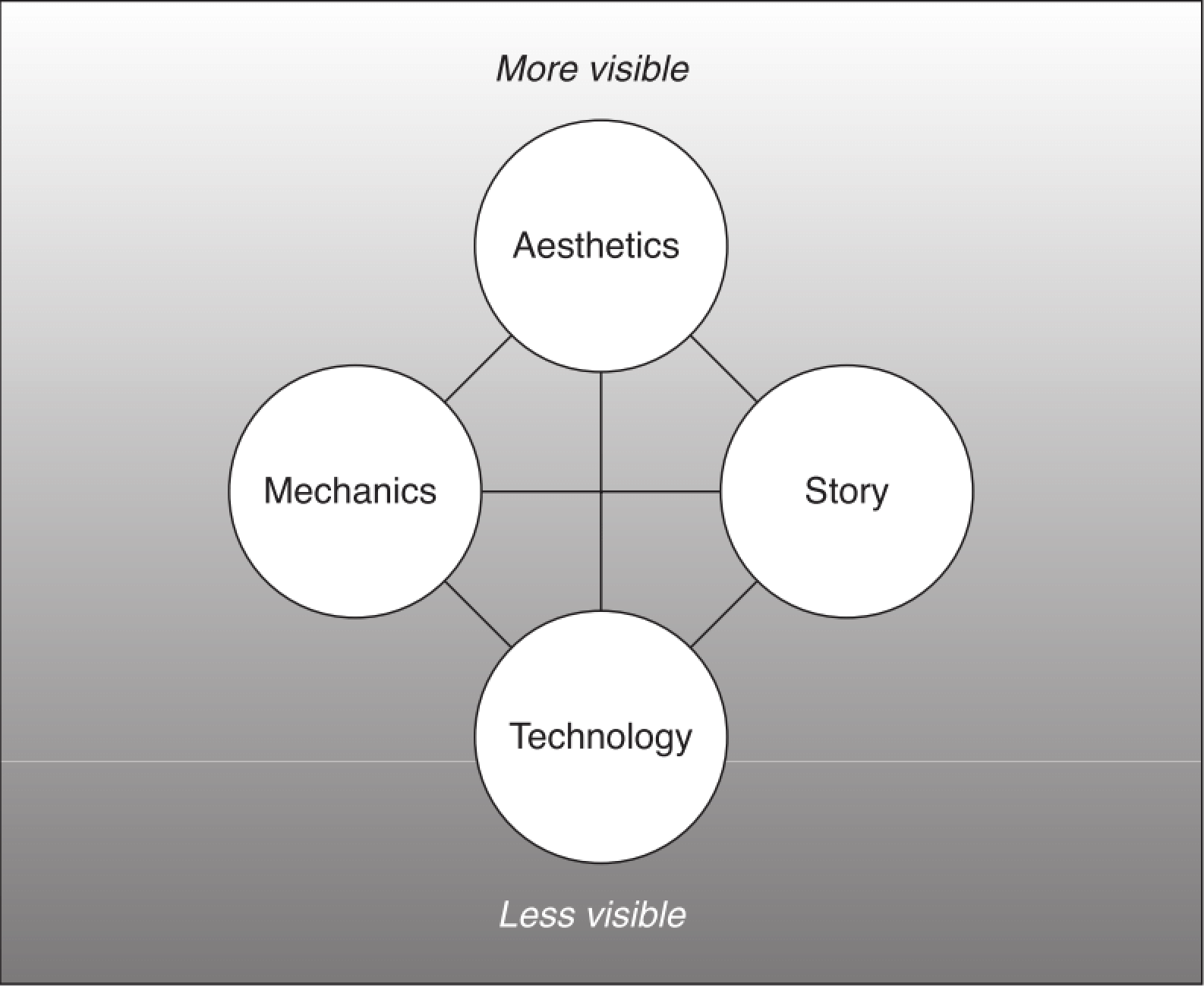
So when I say Nintendo puts the “play” element first, I mean it concentrates on mechanics as the main artifact of the game, and then drives the other elements from it.
First, I really want to emphasize here that while some games concentrate on certain components, their designs do not leave the others off the table. Shigeru Miyamoto says that “a good game designer understands the technology at hand and uses it to deliver the best experience to the player”. It is no accident that he has been involved in every Nintendo joystick ever made, and he also used every aspect of the NES RAM and CPU to make Mario Bros. It is no accident that Nintendo, besides revolutionizing games, also revolutionizes the console industry with the NES, the Wii and the Switch.
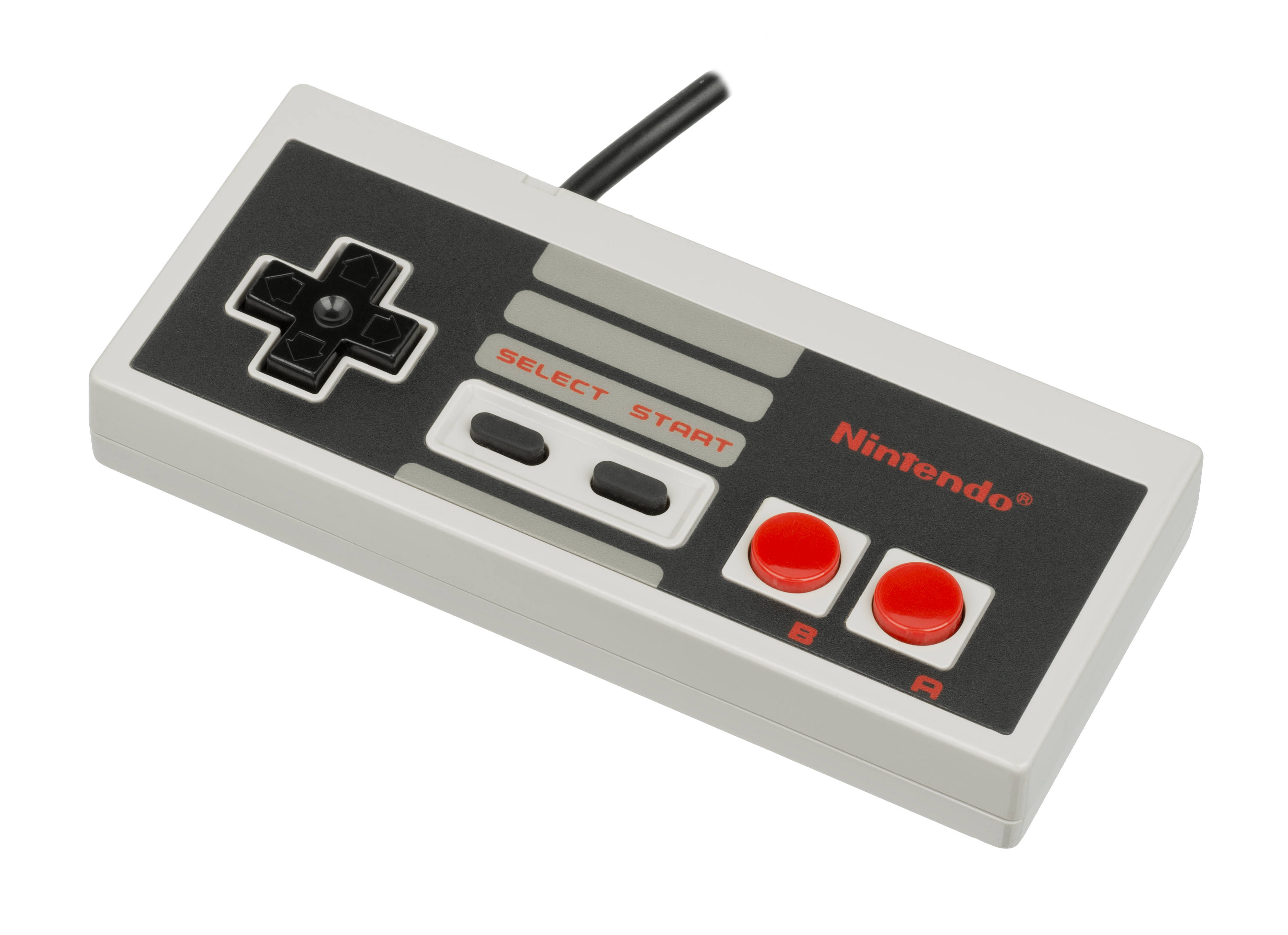
When Shigeru was designing Super Mario Bros. he had in mind the console controller, which had only two action buttons, and thought about how to make the most of that. That is why everything in Mario Bros. makes you take practically a single action: Jump!
By jumping you kill enemies, destroy objects, reach new places, use some power-ups more efficiently, like the fire flower that shoots at a 45-degree angle where, to aim, you have to do only one thing: Jump! One action with many possibilities, easier to program, easier to design, easier to learn and harder to master. Perfect for gameplay.
We have some other examples, like:
-
How Mario jumps, kicks and how we control the camera in Super Mario 64. They developed this whole range of actions because they saw that only jumping in a 3D game would make killing enemies hard, so they always add a second way of defeating enemies, whether kicking, spinning or throwing the cap.
-
The Target Lock with the Z-targeting in Zelda Ocarina of Time. Before it existed, nobody EVER, I repeat, EVER, had thought of a target lock in a 3D adventure game.
-
How they used cinematography with in-game characters, in the games above, instead of CGI like PlayStation games did, purely because of the graphical limitation of the cartridge versus the CD-ROM.
-
The whole concept of Splatoon, an ink warfare with the endogenous value of covering the map, was developed before the art, the music, the story and any other element. If you were a Splatoon beta tester, you would play with blocks shooting ink, even in black and white.
-
In Zelda Breath of the Wild, the first programming was done in a prototype in the mold of the first Zelda and focused on systemic design, to test the interaction of the world’s elements, with little or no player interaction, to give a greater sense of exploration. Then came the quests, world, music, story and even the infamous weapon-breaking mechanic, created to guarantee the player’s exploration experience.
All these games were made by several different Nintendo teams and game designers, but with the same process in mind: Put Mechanics First!
This also helps Nintendo a lot at the Programmer and Game Designer interface. I can say this from being on both sides. Here is an example:
“When you go to a programmer and tell them you need the enemies in your game to move randomly for each player action, you think that is a good thing to ask for. But it is not. If you understand how computers work, random means many things, and a computer is never truly random. If instead you ask: I need the enemies to take any of these specific actions with no predefined order (attack, jump, move) for each player movement, but every 30 frames their action has to move them, that is a much better specification.”
Those are Shigeru Miyamoto’s words, and I complement them with the following point I learned from years in the software industry:
“Programming may not look like it, but it is an extremely human field. Knowing what the user needs is often much more important than programming what they say.”
So as a game designer, it is good to keep in mind that the programmer carries this human bias too, as much as you do!
So, what can we learn from Nintendo:
-
First, you can concentrate on any game component you want, but do not forget the others. Deeply understanding the technology, cinematography, aesthetics, animation and story will leverage your mechanics-focused game, and this is also valid the other way around.
-
Understanding technology can leverage your design process, through documentation and delivery of aspects.
Focusing on play is not the only way to make games, but it certainly is a very interesting one. I will bring other design process approaches from other studios later.